
Applying Calculus in Intelligence Calculations
(The Question of a Coup)
Calculus is the discipline that intelligence didn’t know it was missing!
Yes, calculus is currently the most advanced scientific way to outcalculate the coup with mathematical precision—it's the intelligence toolbook for national stability
Coups are terrifying to leaders and the populace, and for good reasons.
They often appear sudden and extraordinarily dangerous.
Yet, as many security analysts and historians of coups have observed, coups are rarely as spontaneous as they seem.
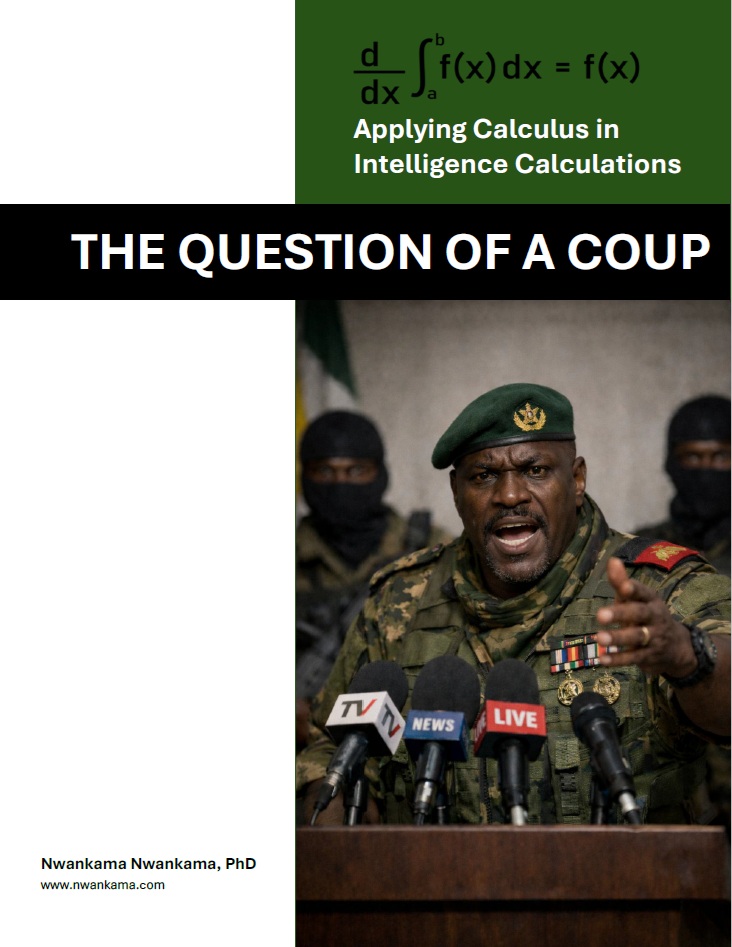
AI-generated image. The image of the military officer is for illustrative purposes only and does not represent any real person or country.
Handshakes remain, but their meaning changes. Behavior analysts describe these moments as signals of shifting loyalty. Assurances are given, yet commitment has already begun to drift, quietly and invisibly. Trusted advisers do not always warn loudly; instead, they fall silent, hedge their language, or retreat from responsibility.
In hindsight, governments rarely fall because no one sensed danger. They fall, as many experts argue, because the danger was misread, minimized, or politically inconvenient to confront—until it is too late. Then the illusion of stability collapses.
One day, an administration stands;
--- the next day, it is gone.
This introductory manual starts where conventional intelligence analysis grows uncomfortable—and grinds to a screeching halt—and that is, sophisticated mathematics. No one likes maths, but it's maths that saves the day, every day. This manual takes a turn most intelligence analysts never expect: Calculus. This is not just equations; it's not academic maths, but a discipline designed to reason under uncertainty, thresholds, and hidden coordination.
Yes, many intelligence failures are driven less by missing information and more by a false sense of certainty.
Calculus accounts for what you do not know! In this case, calculus may be the missing tool leaders never realized they needed.
They start with rumors and hushed whispers among elites. What looks like confidence to the public often masks private doubt. Smiles, scholars note, can become performative—courteous on the surface, but hollow beneath—no longer reassurance, but quiet farewells the leader does not yet recognize.
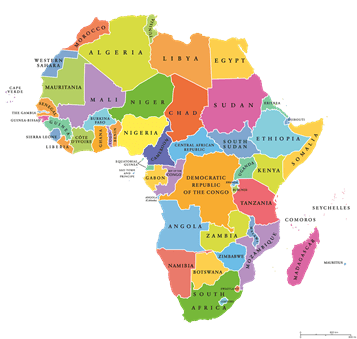
Studies of military takeovers—particularly across parts of Africa—suggest that coups usually begin long before the tanks roll out.
Can the application of advanced mathematical principles help stem coups and support national stability?
ABSOLUTELY!
And, that is Calculus!
What intelligence analysts will get from this manual:
A disciplined way to treat coup risk as a continuously evolving process rather than a binary outcome.
A method for preventing repeated signals from masquerading as independent confirmation.
Practical tools for integrating noisy, incomplete, and deceptive intelligence without forcing premature conclusions.
A calculus-based framework for handling hidden coordination, thresholds, and nonlinear escalation.
Protection against false certainty created by consensus, narrative dominance, or analytic momentum.
Clear guidance on when confidence is warranted, conditional, or unjustified.
An approach that strengthens judgment without replacing experience or tradecraft.
Techniques for briefing senior leaders that explain not just what you assess, but why that level of confidence exists.
Earlier warning without alarmism, even when visible indicators remain weak.
A way to stay analytically ahead of surprise rather than explaining it afterward.
Explore our other recent projects:
National socio-digital early warning and strategic foresight architecture: a computational intelligence ecosystem to anticipate mass sentiment shifts before coordinated unrest and destabilization emerge.
Understanding the Lockwood Analytical Method for Prediction (LAMP): my firsthand experience applying one of the intelligence community’s most rigorous forecasting methodologies.
Self-disruption research: Applied Whitney Johnson's four principles of self-disruption in addressing unconscious bias among intelligence analysts.
Intelligence training manual: Self-disruption as analytic tradecraft
Self-disruption as analytic tradecraft: Classified-style analytic vignettes and tradecraft alignment
Not Intelligence-Related:
Get in touch
Nwankama Nwankama
Email is best (or, you can fill out the Contact form)
nwankama@nwankama.com


Home | About Me | Projects | Blog | Social Media | Contact Us