
Applying Calculus in Intelligence Calculations
(The Question of a Coup)
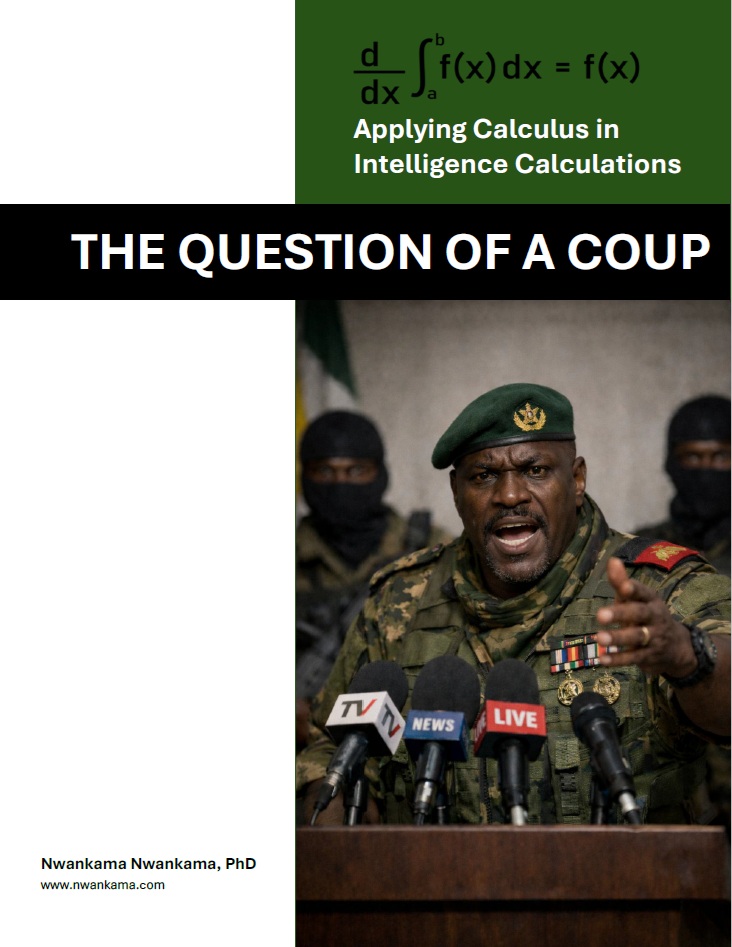
Coups in Africa
Let's examine some well-documented coups in Africa where post-event investigations, memoirs, and expert analyses exactly show the slow-burn patterns of coups:
Elite whispers
Performative loyalty
Silence from insiders, and
Danger being misjudged rather than unseen.
Here are specific, widely studied cases, with the pattern made explicit:
Not arranged in any particular order:
















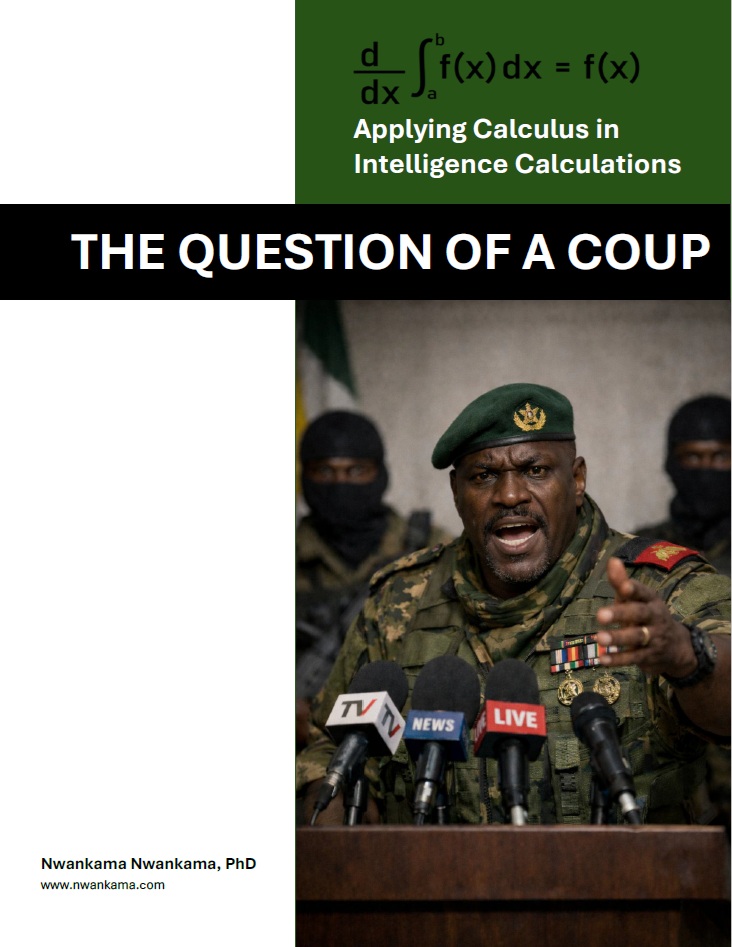
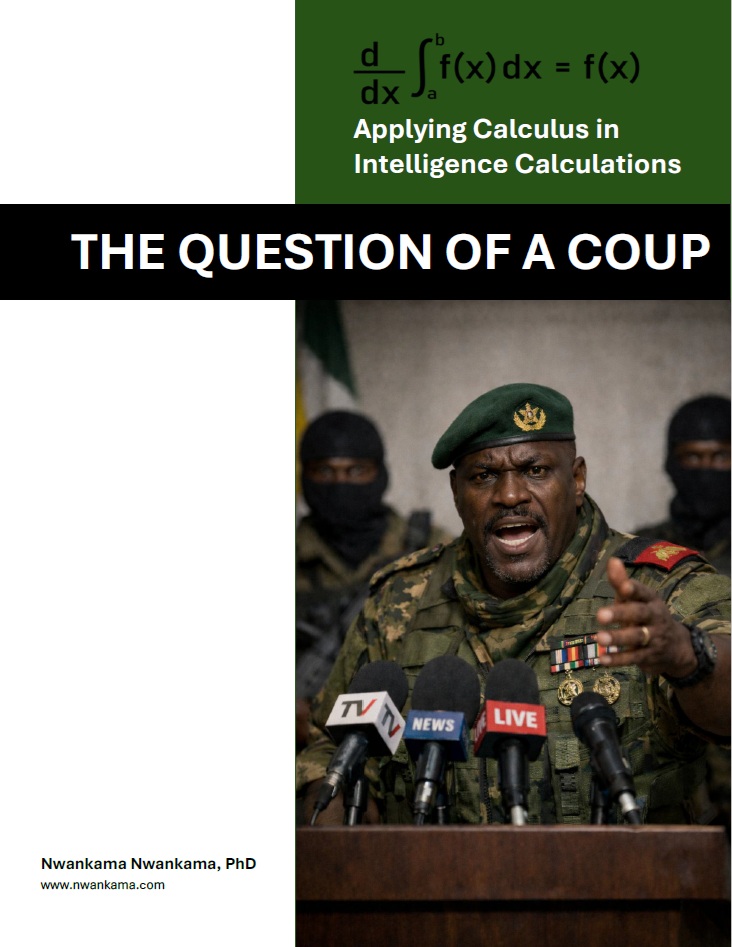
AI-generated image. The image of the military officer is for illustrative purposes only and does not represent any real person or country.


Towards Zero Coups
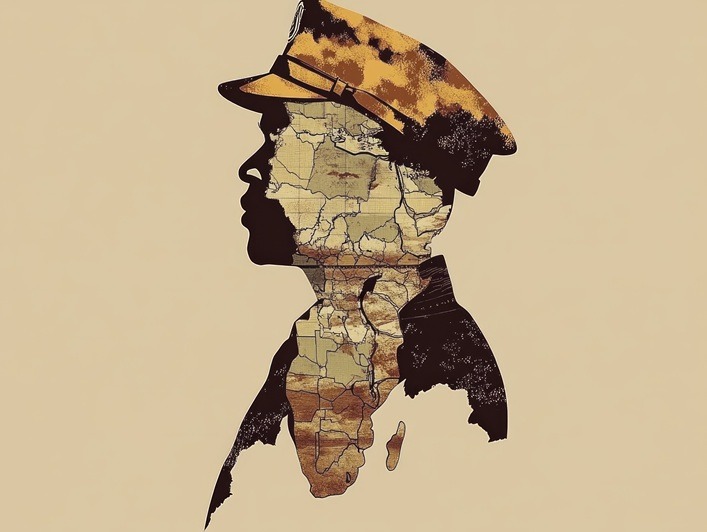
Can the application of advanced mathematical principles help stem coups and support national stability?
ABSOLUTELY!
And, that is Calculus!
Observable Indicators by Coup Type
Here are the coup types that have occurred in Nigeria, as a case example:
Type I: Systemic Collapse
Type II: Guard Coup
Type III: Intelligence Saturation
Type IV: Enforcement Gap
Type V: Elite Exit
Type VI: Custodial Reversion
Across all six Nigerian coup types, the recurring analytic mistake is treating political variables as static levels rather than dynamic functions—leaders read points when they need to read curves: rates of change, accumulation, thresholds, and binding constraints.
Briefly outlined here, in the Coup Risk Diagnostic Grid, is a predictive early-warning framework with (1) observable indicators for each type, (2) a scoring rubric, and (3) a “veto-node map” template analysts can fill in.
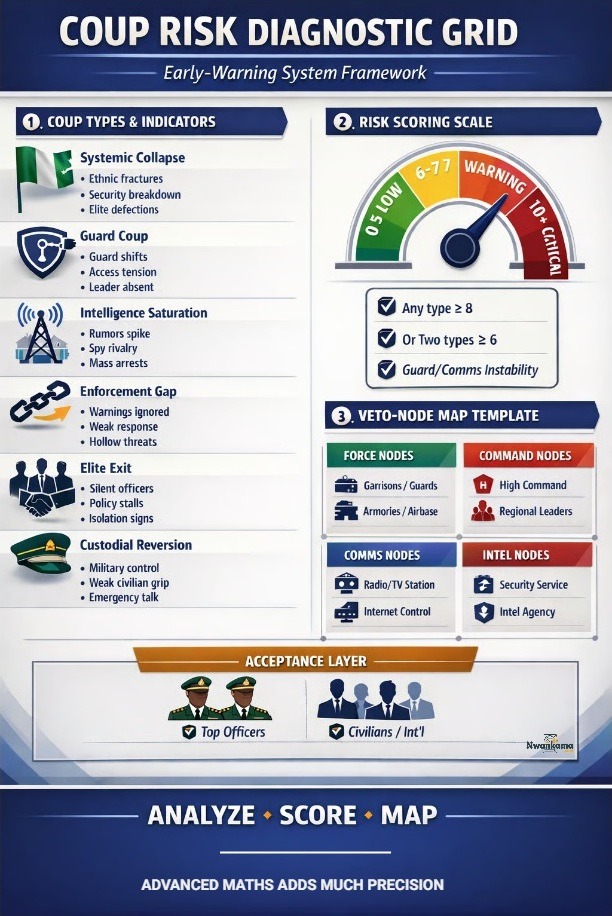
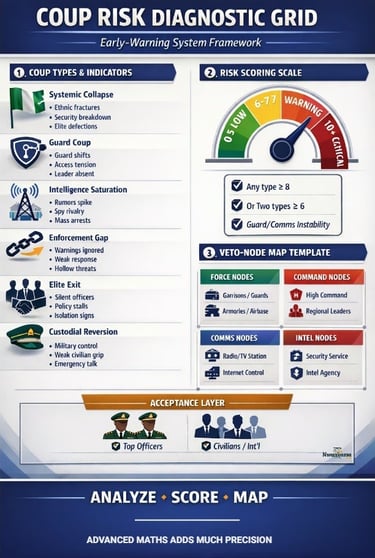
The Coup Risk Diagnostic Grid, integrating observable indicators, a scoring rubric, and veto-node mapping into a single early-warning framework; full templates, analyst sheets, and real-time application guidance are available in the freely downloadable Calculus Applications in Coup Prevention Intelligence Toolkit.
DETAILS
Type I: Systemic collapse coup
What’s breaking: legitimacy + cohesion at accelerating rates (dL/dt steepens)
Indicators (observable)
Sudden acceleration in defections/resignations among elites (not just high discontent)
Public security failures that cascade (riots, mutinies, localized breakdowns)
Open ethnic/regionally patterned refusal to obey central directives
Parallel “authorities” emerging (governors, militias, regional commands acting autonomously)
Fast diagnostic question
Are institutions still functioning, or are they functioning unevenly by identity/region?
Examples of Nigerian Type I Coups
Type II: Preemptive guard coup
What’s breaking: leader access control and protective apparatus loyalty
Indicators (observable)
Guard/special units rotated unusually often or abruptly “restructured.”
Increased “proximity rituals” (forced loyalty ceremonies, staged visits to barracks)
Communication bottlenecks: leader increasingly reliant on fewer aides/handlers
Leader travel patterns become riskier (long absences, medical trips, scant personal guards) without robust continuity plans
Fast diagnostic question
Who controls the physical and communications perimeter around the leader right now?
Examples of Nigerian Type II coups:
The 1975 overthrow of General Yakubu Gowon (Mohammad, successful)
The 1976 attempted overthrow of General Murtala Mohammad (Dimka, failed)
Type III: Intelligence saturation coup
What’s breaking: signal-to-noise collapses; warnings don’t integrate into action (This includes pre-kinetic neutralizations like the Nigerian coups of 1986 and 1995.)
Indicators (observable)
Explosion of rumor volume: “plots” everywhere, inconsistent attribution
Intelligence agencies competing publicly or leaking against each other
Lots of arrests without clear operational evidence (or clear evidence without action)
Sudden tribunal activity / “security announcements” that reshape officer expectations
The state’s internal narrative becomes: “threats are constant, trust no one.”
Fast diagnostic question
Does the regime have a credible threat-filter that converts warnings into timely, targeted action?
Examples of Nigerian Type III coups:
The 1983 overthrow of President Shehu Shagari (Buhari, successful)
The 1986 plot to overthrow General Ibrahim Babangida (Vasta, alleged, failed)
The 1995 plot to overthrow General Sani Abacha (Diya & co., alleged, failed)
Type IV: Enforcement gap coup
What’s breaking: the leader knows the risk but cannot execute deterrence
Indicators (observable)
Repeated warnings followed by symbolic gestures (commissions, speeches) rather than force moves
Promotions/punishments announced but not enforced consistently
Confused command authority: orders require negotiation instead of compliance
Failure to redeploy/secure capital nodes during heightened alerts
“Everyone knows” certain officers are risky—yet they remain in position
Fast diagnostic question
If the leader decided today to neutralize a plot, can they actually move units and arrest actors fast enough?
Examples of Nigerian Type IV coups:
The 1983 overthrow of President Shehu Shagari (Buhari, successful)
The 1990 plot to overthrow General Ibrahim Babangida (Orkar, failed)
Type V: Elite-exit coup
What’s breaking: coalition support quietly evaporates; silence is coordination
Indicators (observable)
Senior officers become publicly inert but privately network more
Policy freezes: leader’s initiatives stall even without open opposition
Increased “elite parking”: rivals moved to ceremonial posts rather than removed
Social distance signals: fewer joint appearances, fewer endorsements, fewer informal consultations
Elite messaging becomes procedural (“constitutional”, “orderly”) rather than loyal
Fast diagnostic question
Is the leadership hearing silence and reading it as stability?
An example of Nigerian Type V coup:
Type VI: Custodial reversion coup
What’s breaking: civilian authority never owns coercion; military “guarantor” reclaims it
Indicators (observable)
Transition arrangements that leave defense/internal security under military control
Civilian government cannot appoint/remove key commanders
Budget/arms procurement bypasses civilian oversight
Security forces operate as separate sovereigns (immunity, autonomy, parallel courts)
“Emergency” language returns: stability, unity, national salvation
Fast diagnostic question
Did coercive ownership transfer, or was it merely “loaned” under a civilian wrapper?
An example of Nigerian Type VI coup:
Scoring Rubric (0–3) + Trigger Rules
Here's the scoring rubric (0–3) and trigger rules:
Score each indicator family 0–3 for each type:
0 = Absent (no credible signals)
1 = Present (sporadic, low intensity)
2 = Active (multiple confirming signals; sustained)
3 = Acute (rapid acceleration; converging evidence; near-term risk)
Weighting (simple and usable)
For each type, compute:
Type Risk Score = (Force Nodes × 2) + (Information Nodes × 1.5) + (Legitimacy Nodes × 1)
Where each component is rated 0–3 based on observation.
Trigger rules
Watch: any type score ≥ 6
Warning: any type score ≥ 8 or two types ≥ 6 simultaneously
Critical: any type score ≥ 10 or one type ≥ 8 plus “Guard/Comms instability” present
Why this mathematical model works
Coups tend to succeed when two domains align (e.g., Guard access + narrative control; or elite exit + enforcement collapse).
Key veto/force nodes
What are veto/force nodes?
“Key veto/force nodes” are the specific people, units, institutions, or physical locations that can decide whether a coup succeeds or fails, regardless of who formally holds power.
Think of them as the real control switches of the state’s coercive system.
In plain terms
They are actors or assets that can:
Block a takeover (veto it), or
Enable a takeover (supply decisive force)
If you control these nodes, you don’t need broad support—you only need the critical few levers that determine outcomes.
Why veto/force nodes matter in intelligence calculations
Most coups are not won by the largest coalition.
They’re won by whoever controls the smallest set of decisive nodes.
In systems terms:
Political power = function(control of veto nodes), not function(number of supporters).
A simple analogy
A country is not a crowd—it’s a circuit.
You don’t need to flip every switch.
You only need to flip the breaker panel.
The Coup Circuit diagram illustrates how veto/force nodes connect and which ones historically matter most:
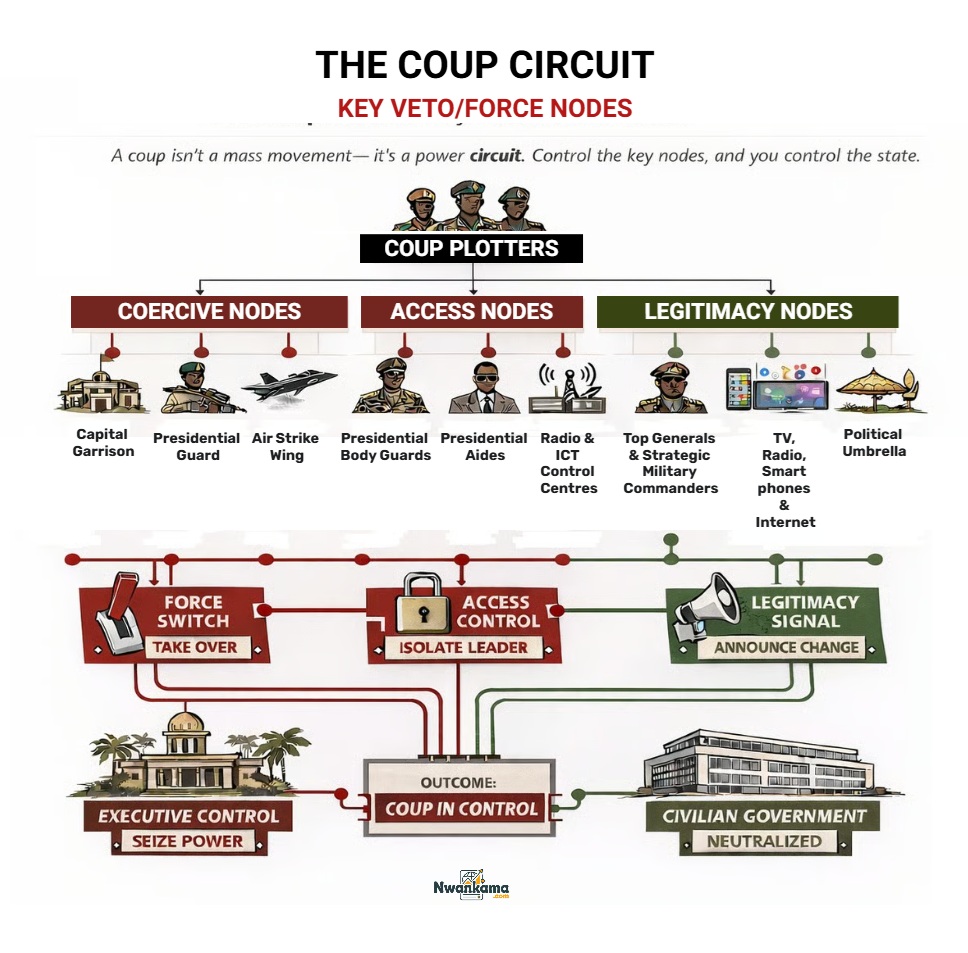
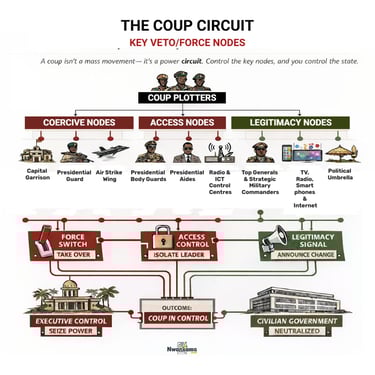
A diagram of a generic “coup circuit map” showing how these nodes connect and which ones historically matter most. A Veto-Node Map Template, “Analysts' Sheet,” and How to use this grid in real time coup prevention are contained in the freely downloadable Calculus Applications in Coup Prevention Intelligence Toolkit.
Types of key veto/force notes
1. Coercive nodes (hard power)
Units or commanders whose loyalty determines who controls violence.
Capital garrison
Presidential Guard
Air Force strike capability
Armored brigades near the capital
2. Access nodes (control of leaders)
Actors who control physical or communication access to leadership.
Chief security officer
Guard commander
Military aides
Communications switchboards and networks
3. Legitimacy nodes (recognition power)
Actors whose endorsement determines whether others obey.
Senior generals
Defense chiefs
Broadcast authority
Supreme court (in hybrid regimes)
The Core Insight
Most coups succeed not because the overthrown leaders knew nothing,
but because they misunderstood movements.
They read levels:
“Is loyalty high?”
“Is the army calm?”
“Is the state functioning?”
When they needed to read curves:
“Is loyalty shrinking faster than before?”
“Is calm masking coordination?”
“Is the system approaching a tipping point?”
This is why people trained to think in dynamics—engineers, analysts, systems thinkers, mathematicians—often spot danger earlier than politicians.
They are not smarter about politics.
They are simply trained to ask a different kind of question:
“What happens next if this trend continues?”
And that, more than ideology or intent, is what decides whether a coup fails—or succeeds.
AI-generated image. The image of the military officer is for illustrative purposes only and does not represent any real person or country.
Common Patterns in the Coups
Other Countries
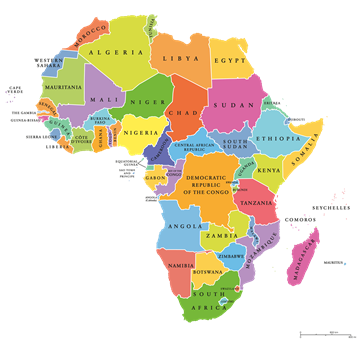
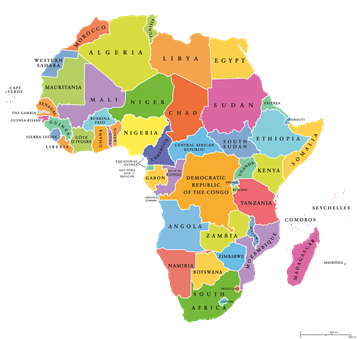
Across these cases, experts consistently identify the same sequence:
Elite discontent becomes private, not public
Rituals of loyalty continue, but substance disappears
Advisers hedge, delay, or fall silent
Leaders mistake formality for fidelity
The coup appears sudden—only in retrospect
One day, an administration stands;
The next, it is gone!
This is why many coup experts argue that coups are not shocks but revelations: the moment when invisible shifts finally become undeniable.
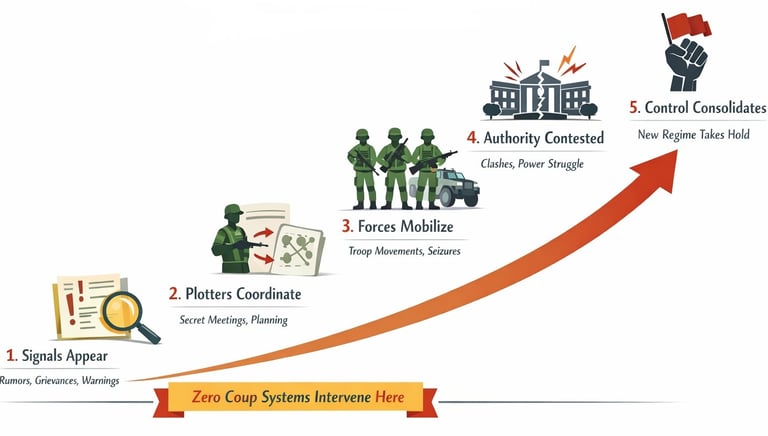
The Coups Trajectory
The Coup Pathway
Signals appear
Plotters coordinate
Forces mobilize (red zone A)
Authority is contested (red zone B)
Control consolidates (red zone C)
Zero Coup systems intervene at stages 1 or 2—never waiting for stage 3 (the red zones).
About the tool book
This free introductory manual starts where conventional intelligence analysis grows uncomfortable—and grinds to a screeching halt—and that is, sophisticated mathematics. No one likes maths, but it's maths that saves the day, every day. This manual takes a turn most intelligence analysts never expect: Calculus. This is not just equations; it's not academic maths, but a discipline designed to reason under uncertainty, thresholds, and hidden coordination.
Yes, many intelligence failures are driven less by missing information and more by a false sense of certainty.
Calculus accounts for what you do not know! In this case, calculus may be the missing tool leaders never realized they needed.
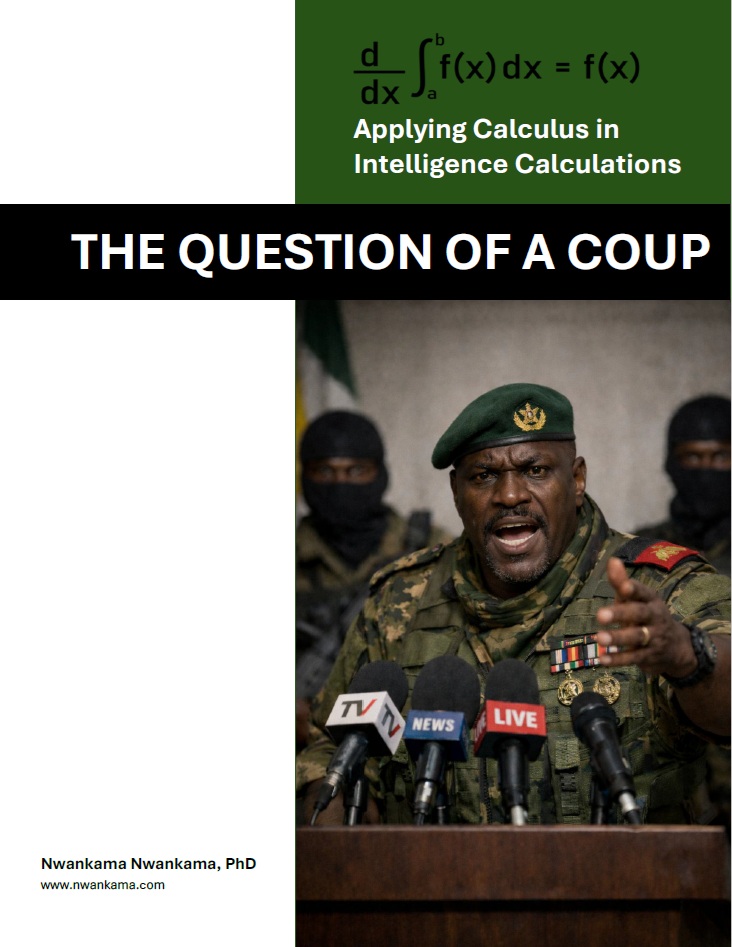
AI-generated image. The image of the military officer is for illustrative purposes only and does not represent any real person or country.
What intelligence analysts will get from this manual:
A disciplined way to treat coup risk as a continuously evolving process rather than a binary outcome.
A method for preventing repeated signals from masquerading as independent confirmation.
Practical tools for integrating noisy, incomplete, and deceptive intelligence without forcing premature conclusions.
A calculus-based framework for handling hidden coordination, thresholds, and nonlinear escalation.
Protection against false certainty created by consensus, narrative dominance, or analytic momentum.
Clear guidance on when confidence is warranted, conditional, or unjustified.
An approach that strengthens judgment without replacing experience or tradecraft.
Techniques for briefing senior leaders that explain not just what you assess, but why that level of confidence exists.
Earlier warning without alarmism, even when visible indicators remain weak.
A way to stay analytically ahead of surprise rather than explaining it afterward.
Explore our other recent projects:
The Question of a Coup: Applying Calculus in Intelligence Calculations: A practical intelligence manual showing how calculus-based reasoning can prevent false certainty, expose hidden coordination, and reduce strategic surprise in coup analysis.
National socio-digital early warning and strategic foresight architecture: a computational intelligence ecosystem to anticipate mass sentiment shifts before coordinated unrest and destabilization emerge.
Understanding the Lockwood Analytical Method for Prediction (LAMP): my firsthand experience applying one of the intelligence community’s most rigorous forecasting methodologies.
Self-disruption research: Applied Whitney Johnson's four principles of self-disruption in addressing unconscious bias among intelligence analysts.
Intelligence training manual: Self-disruption as analytic tradecraft
Self-disruption as analytic tradecraft: Classified-style analytic vignettes and tradecraft alignment
Not Intelligence-Related:
Get in touch
Nwankama Nwankama
Email is best (or, you can fill out the Contact form)
nwankama@nwankama.com


Home | About Me | Projects | Blog | Social Media | Contact Us