
National Socio-Digital Early Warning and Strategic Foresight Architecture
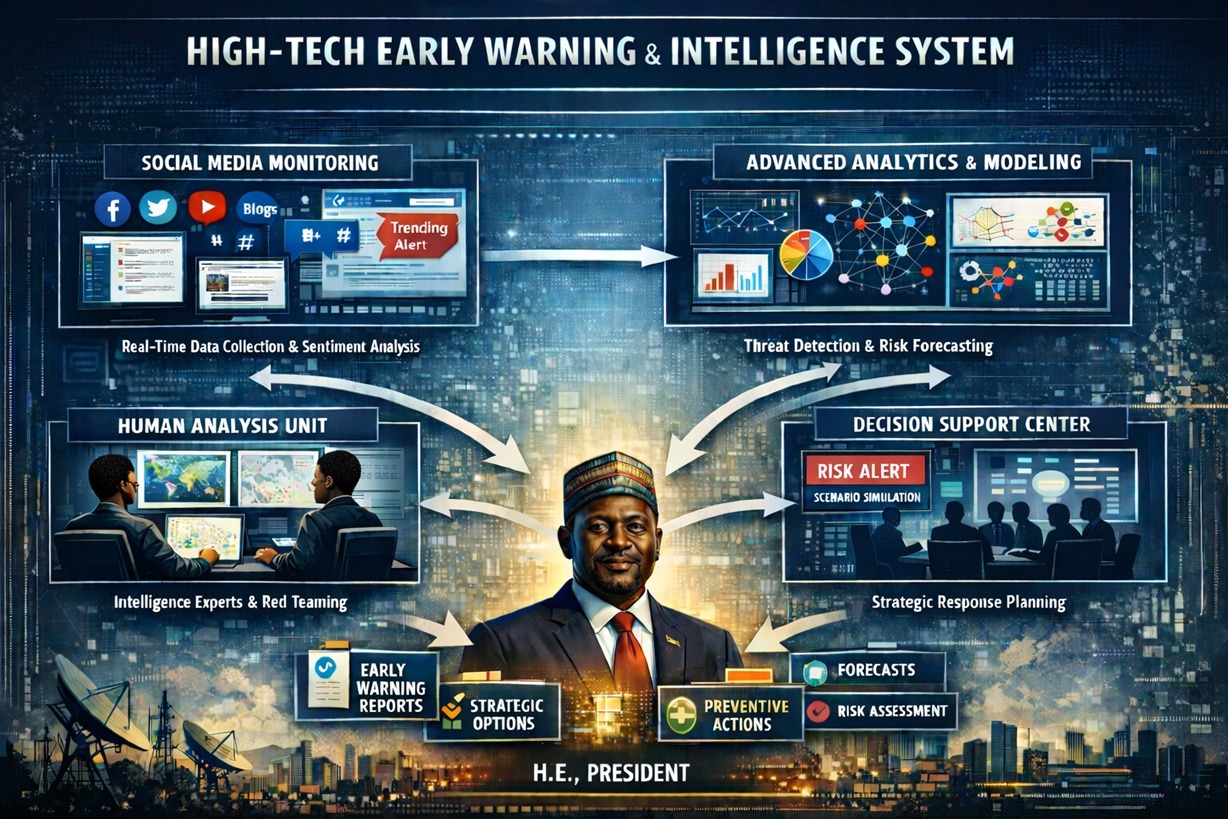


For governments, a key warning indicator for political instability is the rapid amplification of online activism, negative public sentiment, and narratives—including false narratives—through digital platforms, particularly when such mobilization occurs in environments where coup risk, internal strife, or external military aggression remains present.
Overconfidence!
No government ever assumes it could be the next to face sudden destabilization. Leaders watch other nations destabilized by insurrections or direct external attacks, or unravel in other ways. They watch regimes collapse, and tell themselves that their own system is different. They assure themselves that they are more secure, more insulated, and have a more loyal population, and are backed by faithful forces and dependable foreign allies.
But history shows this overconfidence is usually the first and most dangerous miscalculation.
The upheavals of the Arab Spring and parallel unrest across Africa and Europe in the early 2010s, which destabilized societies and toppled many governments that were thought to be impregnable and stable, revealed a dangerous reality: conventional security systems detect crowds and weapons, but not narratives, emotions, or cascading belief shifts that now ignite instability.
In response, this project created not a traditional surveillance platform, but a computational intelligence ecosystem designed to sense, model, and anticipate mass sentiment dynamics before they could metastasize into coordinated unrest.
Causes of nationwide riots
Some usual causes of the destabilizing upheavals include:
Rising energy shortages
Concentration of power under authoritarian rule or absolute monarchies
Demographic pressures
High inflation and economic instability
Systemic looting of the state (kleptocratic governance)
Widespread political corruption
Entrenched poverty
Sectarian divisions
Extreme acts of protest, such as self-immolation
Chronic unemployment
Objectives
Typical objectives pursued by the angry masses include:
The demand for genuine democratic governance
Greater economic autonomy and opportunity
Job creation and access to employment
Transparent and competitive elections
Structural and institutional reform
Removal or replacement of ruling regimes
Tactics
Commonly employed tactics and pathways include:
Nonviolent and violent civil resistance, including civil disobedience
Mass protests, demonstrations, and organized sit-ins
Protest encampments and silent symbolic actions
Strike actions and labor shutdowns
Digital mobilization through the internet and media activism
Defections and mutinies within security forces
Armed rebellion, insurgency, and civil war
Riots and urban combat
Revolutionary movements
Extreme protest acts such as self-immolation
Results
Frequently observed outcomes of national riots include:
Loss of life and widespread destruction of property
Overthrow of governments and ruling systems
Erosion of political legitimacy and national cohesion
Adoption of new constitutions or major constitutional reforms
The Intelligence System
At its core of the system was a multi-layer socio-technical intelligence stack composed of four tightly coupled components:
A global-scale digital signal collection layer
An advanced computational analytics and modeling layer
A strategic human intelligence fusion and red-team layer
A decision support and preventive action interface.
The system was conceived not to suppress dissent, but to function as a scientifically grounded national immune system—preserving stability, protecting sovereignty, and enabling wise governance in an era where a single viral social media narrative (or even doctored image) can destabilize a nation overnight. Early detection replaces brute reaction; intelligence replaces surprise; foresight replaces regret.


Other sample intelligence analysis projects:
Get in touch
Nwankama Nwankama
Email is best (or, you can fill out the Contact form)
nwankama@nwankama.com


Home | About Me | Projects | Blog | Social Media | Contact Us