
National Socio-Digital Early Warning and Strategic Foresight Architecture
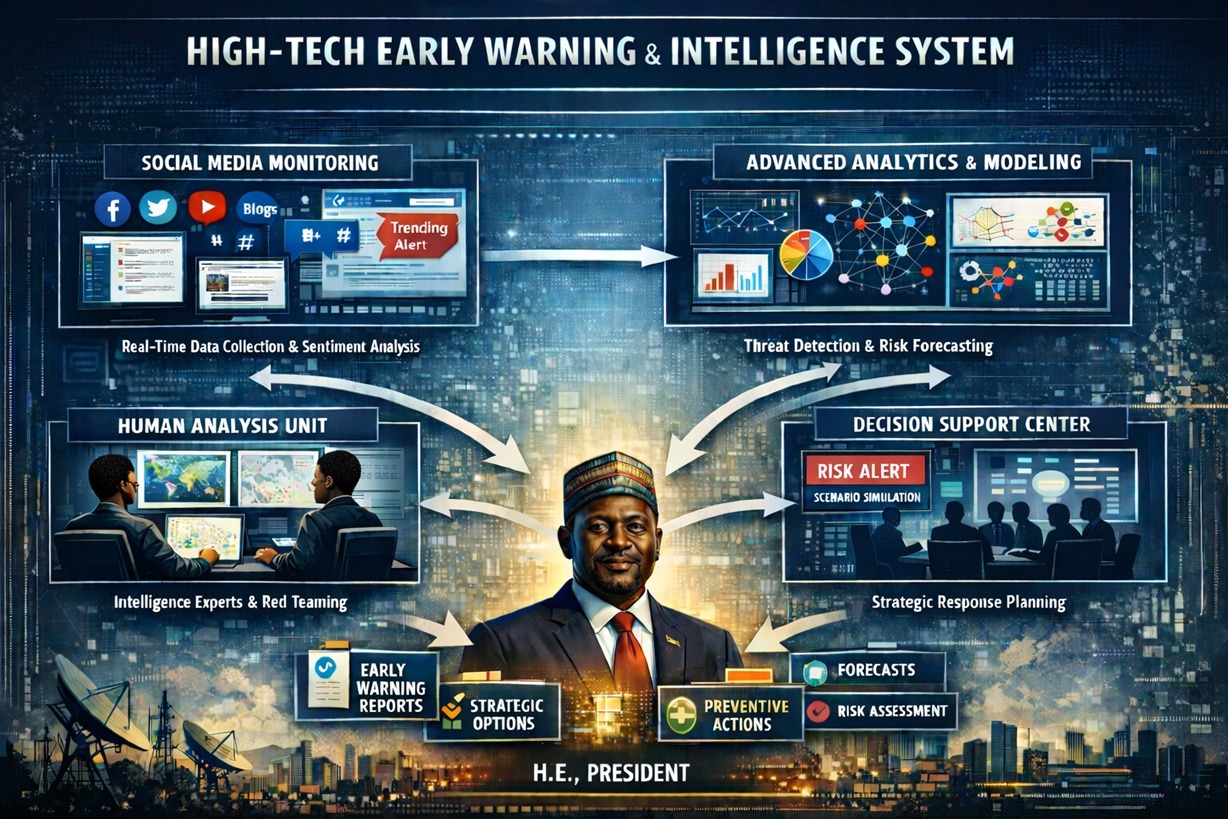


Many of the most dangerous threats to 21st-century governments are no longer born in barracks or battlefields, but on computer keyboards and cell phones—where narratives ignite, emotions mobilize, and revolutions begin before a single soldier moves.
Project layers
At the core of the system was a multi-layer socio-technical intelligence stack composed of four tightly coupled components:
A global-scale digital signal collection layer
An advanced computational analytics and modeling layer
A strategic human intelligence fusion and red-team layer
A decision support and preventive action interface.
1. Global-scale digital signal collection layer
This layer continuously ingested open-source, legally accessible digital output from social media, blogs, forums, diaspora websites, messaging spillovers, and online news ecosystems. Rather than keyword scraping, it used semantic graph extraction, topic diffusion tracking, and cross-platform narrative propagation analysis to identify emergent grievances, framing shifts, and meme-level contagion.
Key capabilities included:
Early detection of weak signals, sentiment inflections, and rhetorical escalation
Identification of externally seeded narratives versus endogenous discontent
Mapping of influence networks, narrative brokers, and amplification hubs
The emphasis was not monitoring individuals, but monitoring collective dynamics.
2. Advanced computational analytics & modeling layer
This layer transformed raw digital signals into actionable intelligence using advanced scientific methods well ahead of mainstream adoption in 2011.
It employed:
Nonlinear time-series analysis to detect accelerating grievance cycles
Bayesian belief networks to model causal pathways between economic stressors, identity narratives, political triggers, and mobilization risk
Complex adaptive systems modeling to simulate tipping points and cascade scenarios
Early-warning indicators derived from systems theory (critical slowing down, variance spikes, coherence shifts)
This allowed the system to answer questions traditional intelligence could not, such as when dissatisfaction becomes mobilization, and when mobilization becomes uncontrollable.
3. Strategic human intelligence fusion & red team layer
Technology alone was insufficient. The system therefore embedded highly trained human analysts operating under structured analytic tradecraft.
Processes included:
Competing hypothesis generation and falsification
Adversarial “red teaming” to model opposition strategies and narrative weaponization
Cognitive bias mitigation protocols
Scenario war-gaming aligned with computational outputs
Analysts were trained not as reporters, but as sense-makers, translating probabilistic warnings into strategic options for leadership.
4. Decision support & preventive action interface
The final layer translated complex analytics into executive-level foresight, not alarms.
It provided the decision-maker with:
Probabilistic risk dashboards (not certainty claims)
Scenario-based policy stress tests
Early intervention windows emphasizing non-kinetic, legitimacy-preserving responses
Guidance on narrative correction, social pressure release, and strategic communication timing
The objective was prevention through anticipatory governance, not repression.
Strategic philosophy
The system was built on a fundamental insight proven by Egypt, Libya, and others:
Regimes do not fall because they lack force; they fall because they lack foresight.
The real battlefield had shifted from streets and barracks to perception, narrative velocity, and collective psychology, often orchestrated transnationally and asynchronously.
This architecture allowed political leaders to:
Detect destabilization months before visible unrest
Distinguish genuine domestic grievances from engineered agitation
Act early, proportionately, and intelligently—before legitimacy eroded
Training & Institutional Transformation
Beyond technology, the project offered:
Executive education in modern intelligence paradigms
Analyst training in computational reasoning and probabilistic judgment
Advisory support to institutionalize foresight as a permanent governance capability
Bottom line
The project was not a tool to suppress dissent, but a scientifically grounded national immune system—one designed to preserve stability, protect sovereignty, and enable leadership to govern wisely in an era where a single viral narrative could destabilize a nation overnight.
In short it was based on the fact that early detection replaces brute reaction; intelligence replaces surprise; foresight replaces regret.
Other sample intelligence analysis projects:
The Question of a Coup: Applying Calculus in Intelligence Calculations
National socio-digital early warning and strategic foresight architecture
Understanding the Lockwood Analytical Method for Prediction (LAMP)
Intelligence training manual: Self-disruption as analytic tradecraft
Classified-style analytic vignettes and tradecraft alignment
Get in touch
Nwankama Nwankama
Email is best (or, you can fill out the Contact form)
nwankama@nwankama.com


Home | About Me | Projects | Blog | Social Media | Contact Us